If you never heard of Winnetou, the noble Apache, or Hadschi Halef Omar, the slightly comical, but incredibly loyal Arab, it will be difficult for you to share my excitement. I grew up reading Karl May’s fantastic stories about Apaches, Comanches, black horses, Indian beauties, fights with grizzly bears, Middle Eastern countries, sneaky visits to Mecca – so it was a pleasure to stand on the grounds Karl May spent the last quarter of his life at. Villa Shatterhand and Villa Bärenfett – they host a collection about May’s life and a large and comprehensive collection of North American Indian artefacts. They don’t show the scalps any more, though.
The most famous rifles of the Wild West: Henry rifle, Bear killer and Silver rifle (Henry Stutzen, Bärentöter und Silberbüchse). Any reader who grow up with these rifles and their heroic owner will stand there in awe. Whilst wondering whether Karl May actually had lost his marbles…
And I thought, they were fiction. So did Karl May, until he eventually decided to let them come alife.
The Karl May Museum is outside Dresden in Radebeul, easily reached by tram – it is just a 8km ride from the historical centre of Dresden.
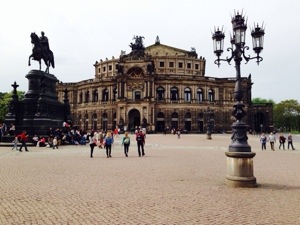
Last night we went to see Mozart’s ‘Cosi fan tutte’ in the Semper Opera. Before the 7pm performance we had booked a guided tour of the building starting at 5.45pm. The tour turned out not much of a tour but a very interesting session about the history of the building and its architect: Gottfried Semper was an interesting character who seemingly had no problems to bite the hands that fed him (he joined the group around the 1848/49 anti-royal revolution, which plotted against the kings that commissioned him to build opera houses). That said, the quality of his work was so outstanding, that the Kings still asked him to create these buildings. He build the first version of the Semper Opera (or the Saxon State Opera) in 1841. Unfortunately a devastating fire destroyed this building, so, despite his known revolutionary ambitions, he was commissioned to lead the reconstruction, apparently mostly driven by the will of Dresden’s population.
He didn’t feel safe to appear in Dresden in person, though, so he sent his son Manfred to supervise the construction work. Gottfried Semper had an interesting thought: he considered opera an illusion and he wanted this illusion to start for the spectators the moment they set foot into the opera house. Worked with me: I had a wonderful evening in the Semper Opera – from entering the building until a late dinner in the “Alte Meister” Restaurant at the Royal Palace.
Bomber Harris – eat this! It took the brave British and American Airforce bomber only one night, the 13th of February 1945, to destroy the inner city of one of Europe’s most beautiful towns. Seeing that the Brits knighted the leader of this atrocity and erected a monument to hail his, well, whatever, bravery it MUST have been in the name of humanity. Clearly every church building and opera house in Nazi Germany was a vital cog in the Nazi’s killing machinery and thus had to be destroyed. Along with 25.000 civilians – killed in the firestorm of that night. The more admirable, that it has been restored – with the Frauenkirche becoming the crowning masterpiece of a restoration effort which was supported by generous people all over the world (who probably share some of the sentiments that I’m expressing here). Now, looking at the perfect and entirely peaceful beauty of this place I cannot find a single reason that justifies the decision of the allied force to eradicate this place and slaughter thousands of civilians. Not quite the same league as Hitler’s Nazis, Stalin’s soviets, Mao’s party cadre or Pol Pot’s Red Khmer, but the same sport: inflicting massive pain on largely innocent people and destroying cultural values. Well done, boys. Anyway, back to Bomber Harris: eat this – Dresden is back!
Travelling! The bug never dies, I think. Ever since Max, who turned 8 in Dec 2013, was born, there was very little of it. Family holiday – yes. Swank hotel on Crete (Domes of Elounda, it rocks for what it is – a family and probably honeymoon place, even though I don’t quite see how that goes together. I experienced the family part and that was abso.f.ing.lutely fantastic – leave out the buffet food), business trip here and there (Bonn, the former capital of Germany a frequent destination, some trips to France, lots of journeys to lots if places for a two hour meeting), a few days in Delhi to visit a partner company – that was the extent of my travelling in the last few years. And now this trip to Kazakhstan, the great unknown. Still largely unknown, demystified, but just to an extent with a lot of curiosity still to be satisfied.
While I thought that I knew what it means to take the red-eye-clipper at 6.50 int the morning the term took on a new dimension with my 3.50am flight from Almaty to Frankfurt. Next stop:
Traffic, as it turns out, is fairly harmless in Almaty. Pollution aside, which is horrendous, the traffic flows fairly well through the rather spacious perpendicularly aligned streets. Since the earthquake towards the end of the 19th century, which pretty much wiped out the garrison town of Verniy, as it was known then, Almaty has been rebuild with relatively wide streets which cope with the traffic quite reasonably. I have read otherwise, so bear in mind that this observation merely reflects what I have experience in the two weeks I have been here.
Cars range from oldish to new and flashy – there’s quite a selection of Bentleys on the road (sold by a local dealer), you see a lot of Porsche Cayennes and BMW X5’s, I have already mentioned the ubiquitous Toyota Landcruiser Prado. Most of them are in good shape; the local attitude towards cars is closer to the French approach then to the German “my car is my castle” attitude.
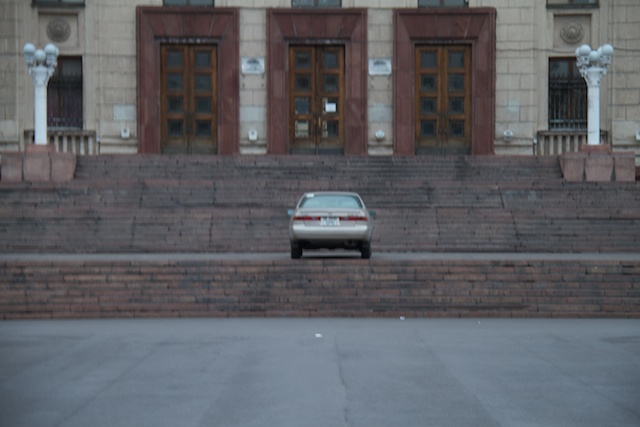
The owner of this car will be getting a ticket, won’t he?
Driving behaviour in general is very civilised, even though I have no idea what the driver of this car thought when he parked it at the stairs.
Having spent more than a week in Almaty now, albeit with a limited set of experiences due to having to spend my time with other things than exploring the town and, for that matter, Kazakhstan, it is time to share a few observations.
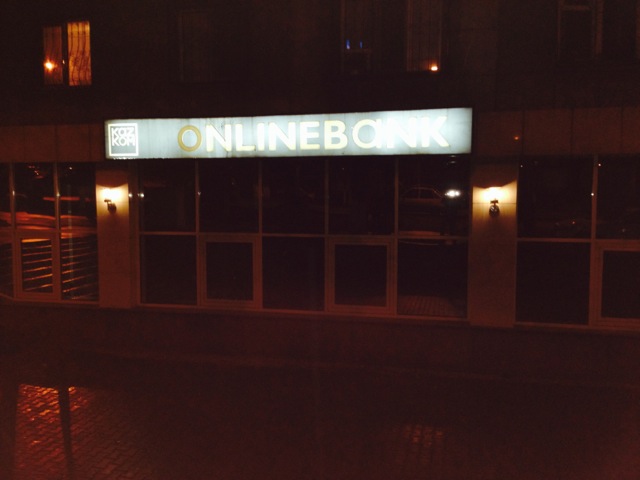
Online banks: I thought online banks were virtual organisations only present in the internet. I remember when Egg started business in the UK – I was quite attracted by the idea of having a lean easy bank that does what I want it to do: take care of my money, give me access to it when I need it – and all of this without having to bother to go to a high street branch. It seems there is a bank around here, that does not fit my understanding of an online bank:
Online bank? Doesn’t look like it. Seen in Almaty.
The photo isn’t very good, but I think you’ll see the interesting bit all the same. Puzzling…
F… the system: I am so glad, that virtually everywhere we can find people who feel that they have to publicly express their differentiated view on this world. Should you have read Alexander Solzhenitsyn’s book, One Day in the Life of Ivan Denisovich, about the Soviet labour camps – he is describing his experiences in a Kasakh Gulag close to the city of Karaganda – you might have been shocked by the stories of completely innocent people having to go through the unthinkably cruel life in the Gulag. Now, I am not saying that somebody who quintessentially damages somebody else’s property by spraying stupid statements, in this case without even the faintest trace of artful aesthetics, should spend years in the Gulag. But, whoever the brave sprayer was, he would have been much braver had he done his work during the Stalin period. Which, thankfully, has been over a long time.
F.. the system, the sprayer says.. F… the sprayer, I say. Seen on the way and close to Gorky Park.





 Who's been here?